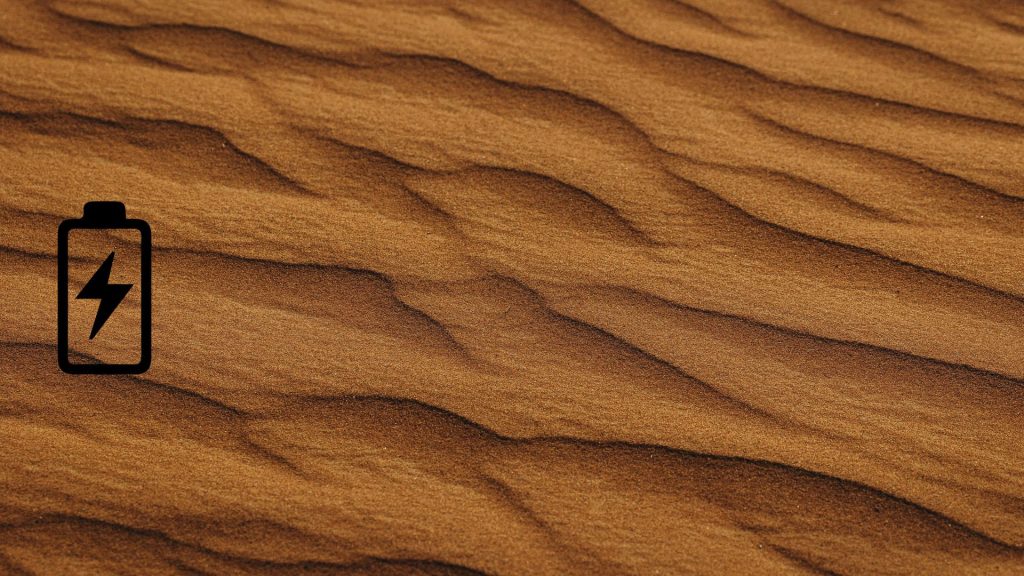
The Australian Technology Turning Quartz into a Thermal Battery
In the global search for efficient and affordable energy storage, innovation does not always come from rare materials or complex chemistry. Sometimes, it comes from the ground beneath our feet. In Australia, a country defined by vast deserts and extreme sunlight, researchers and energy entrepreneurs are rediscovering an unlikely resource: quartz sand.
According to renewable energy entrepreneur Ariel Malik, this approach represents a shift in how we think about storage itself. “Not every energy solution needs to be high‑tech in appearance,” Malik explains. “Some of the most resilient systems are built on materials that are already abundant, stable, and well understood.”
How sand-based thermal storage works
The concept is deceptively simple. During daylight hours, surplus solar energy is used to heat large volumes of quartz sand to extremely high temperatures. That heat is stored within insulated containers and released gradually when energy is needed, often at night or during peak demand.
Unlike conventional batteries, these systems do not rely on electrochemical reactions. Instead, they store energy as heat, which can later be converted into electricity or used directly for industrial processes, heating, or desalination.
“Sand doesn’t degrade the way chemical batteries do,” says Malik. “It can withstand thousands of heating cycles with minimal loss, making it ideal for long‑term, low‑maintenance storage.”
Why Australia is leading this approach
Australia’s geography makes it uniquely suited for sand‑based thermal storage. The country combines intense solar exposure, large remote communities, and limited grid infrastructure in many regions. Transporting fuel or installing lithium battery systems in these areas is expensive and logistically complex.
By contrast, quartz sand is local, inexpensive, and widely available. Systems can be built close to where energy is produced and consumed, reducing dependency on long transmission lines and imported materials.
“This is about energy sovereignty,” Malik notes. “When remote communities can store their own solar energy using local materials, they gain resilience and independence.”
A low‑cost alternative to lithium
One of the most compelling aspects of sand‑based storage is cost. While lithium batteries offer high energy density, they also involve mining, complex supply chains, and rising prices. Thermal sand storage trades compactness for durability and affordability.
For applications that do not require instant discharge, such as overnight heating or steady industrial output, sand storage can outperform batteries on cost per cycle.
“We need to stop assuming that one storage technology fits all,” Malik says. “Sand systems won’t replace lithium everywhere, but in the right context, they are remarkably efficient.”
Environmental and social benefits
Beyond economics, the environmental footprint of sand‑based storage is minimal. Quartz sand is non‑toxic, recyclable, and does not require chemical processing. There is no risk of fire, leakage, or heavy metal contamination.
In addition, these systems can be manufactured locally, creating regional jobs and reducing dependence on global supply chains. For developing or isolated regions, this combination of safety, simplicity, and accessibility is especially valuable.
“When sustainability meets practicality, adoption becomes much easier,” Malik adds. “That’s what makes this technology so promising.”
Looking ahead
Several pilot projects in Australia and Northern Europe are already demonstrating the viability of sand thermal storage at scale. As renewable penetration increases worldwide, demand for diverse storage solutions will only grow.
Sand may not look like the future of energy at first glance, but its role is becoming clearer. In a world searching for clean, stable, and affordable storage, sometimes the smartest answer is also the simplest.
As Ariel Malik puts it, “The future of energy isn’t only about inventing new materials. It’s also about reimagining how we use the ones we already have.”
Google+