
By Ariel Malik
In the search for smarter, cleaner, and more resilient buildings, the next leap forward may not come from silicon, steel, or concrete, but from something alive. In northern Australia, where heat, humidity, and urban growth collide, experimental algae-based building systems are quietly reshaping how we think about insulation, energy storage, and even air quality.
As Ariel Malik sees it, this shift is part of a broader redefinition of what buildings are meant to do.
“A building should no longer be a passive consumer of energy,” Ariel Malik explains. “It should participate in the local climate, regulate itself, and contribute positively to its surroundings.”
From Biology to Building Performance
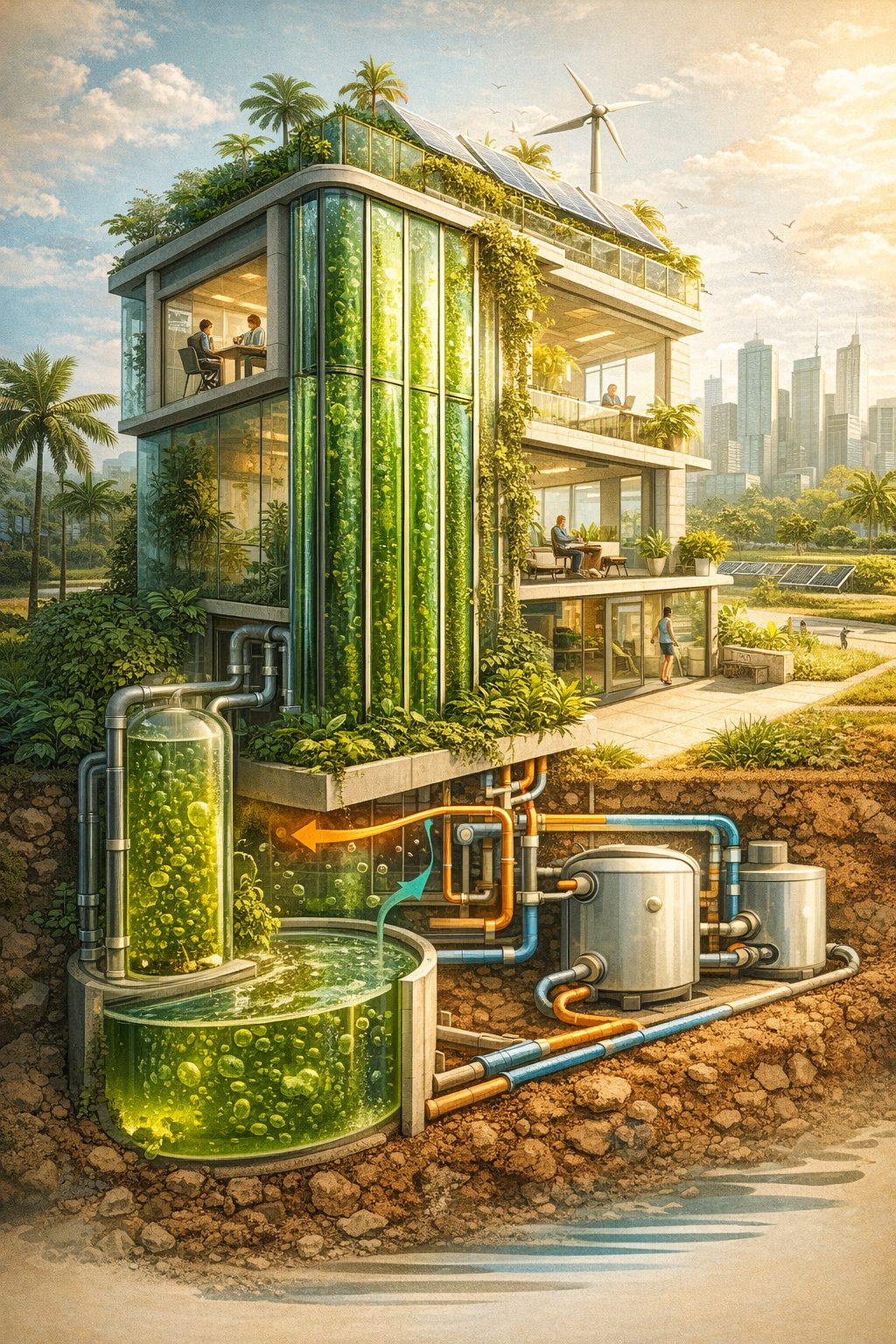
Algae have long been studied for their potential as biofuels, but their architectural value is only now coming into focus. Certain algae species naturally absorb carbon dioxide, regulate temperature, and respond dynamically to sunlight. When integrated into building façades or wall systems, they create what researchers call a bio-reactive envelope.
In practical terms, these algae-based walls act as living insulation layers. During the day, they absorb solar radiation and heat, reducing thermal load inside the building. At night, the stored thermal mass helps stabilise interior temperatures. In tropical and subtropical regions of Australia, this balance is especially valuable.
According to Ariel Malik, “In climates where cooling costs dominate, even small gains in passive insulation can translate into major energy savings over time.”
A Wall That Stores, Breathes, and Adapts
Unlike conventional insulation, algae walls are not static. They adapt continuously to light intensity, temperature, and air quality. Some pilot systems circulating in Darwin and Cairns use transparent panels filled with nutrient-rich water where algae grow and multiply. As they photosynthesise, they absorb carbon dioxide from the surrounding air and release oxygen, improving local air quality.
At the same time, the water medium acts as a thermal buffer, slowing heat transfer through the building envelope. This dual function, insulation plus carbon capture, positions algae walls as both an energy solution and an environmental tool.
Ariel Malik describes this as a turning point.
“We are moving from materials that resist nature to systems that collaborate with it.”
Energy Storage Without Batteries
One of the most intriguing aspects of algae-based systems is their role in energy storage. While they do not store electricity directly, they store energy in biological and thermal form. Biomass growth represents captured solar energy, which can later be harvested for bioenergy or processed into secondary products. Meanwhile, thermal stability reduces demand peaks on air conditioning systems.
For urban planners and developers, this offers a different way to think about resilience. Instead of adding more mechanical systems, buildings themselves become part of the energy equation.
In Ariel Malik’s view, “This is storage at the building scale. It reduces stress on the grid without anyone needing to change their daily habits.”
Northern Australia as a Natural Testbed
Australia’s northern regions provide ideal conditions for these experiments. High solar exposure, warm temperatures, and growing urban centres make algae systems both efficient and economically relevant. Universities and research centres are partnering with local councils to test algae façades on public buildings, transport hubs, and mixed-use developments.
The lessons learned here are likely to travel well beyond Australia. Cities across Southeast Asia, the Middle East, and parts of Africa face similar climatic pressures.
As Ariel Malik notes, “What works in Darwin today may shape how cities in the tropics are built tomorrow.”
Challenges and Realism
This is not a silver bullet. Algae systems require maintenance, water management, and careful design to avoid operational issues. Regulatory frameworks are still catching up, and construction industries tend to move cautiously when faced with living materials.
Yet progress is steady. Costs are falling, monitoring systems are improving, and hybrid designs combining algae walls with conventional insulation are proving effective.
“The goal is not to replace everything overnight,” Ariel Malik says. “It’s to introduce intelligence and biology where they make the most sense.”
A New Relationship Between Buildings and the Environment
At its core, the algae wall represents a philosophical shift. Buildings are no longer sealed boxes fighting their environment. They become porous, responsive systems that interact with light, heat, and air.
For Ariel Malik, this is where the future of sustainable construction is headed.
“When a wall can cool a home, clean the air, and store energy at the same time, you’re no longer talking about architecture alone. You’re talking about ecosystem design.”
Looking Ahead
As Australia continues to explore climate-adapted construction, algae-based insulation and storage systems offer a compelling glimpse of what is possible. They remind us that innovation does not always mean more machinery or more consumption. Sometimes, it means letting life itself do part of the work.
In the words of Ariel Malik, “The most advanced buildings of the future may not look futuristic at all. They may simply be alive.”
Google+